By Marc Debrody, Founder and CEO, Sentinel Protection Solutions
An IRS 132 security assessment and an Independent Security Study are two names for the same work: the study described in Treasury Regulation Section 1.132-5(m). An executive risk assessment is a broader term for any review of the risks an executive faces, and it may or may not meet the conditions that regulation sets.
The three terms are often used as if they were interchangeable, in proposals, in board materials, and in conversations among security, tax, and legal teams. Knowing which one you are being offered, and which one you need, helps a company commission the right work the first time.
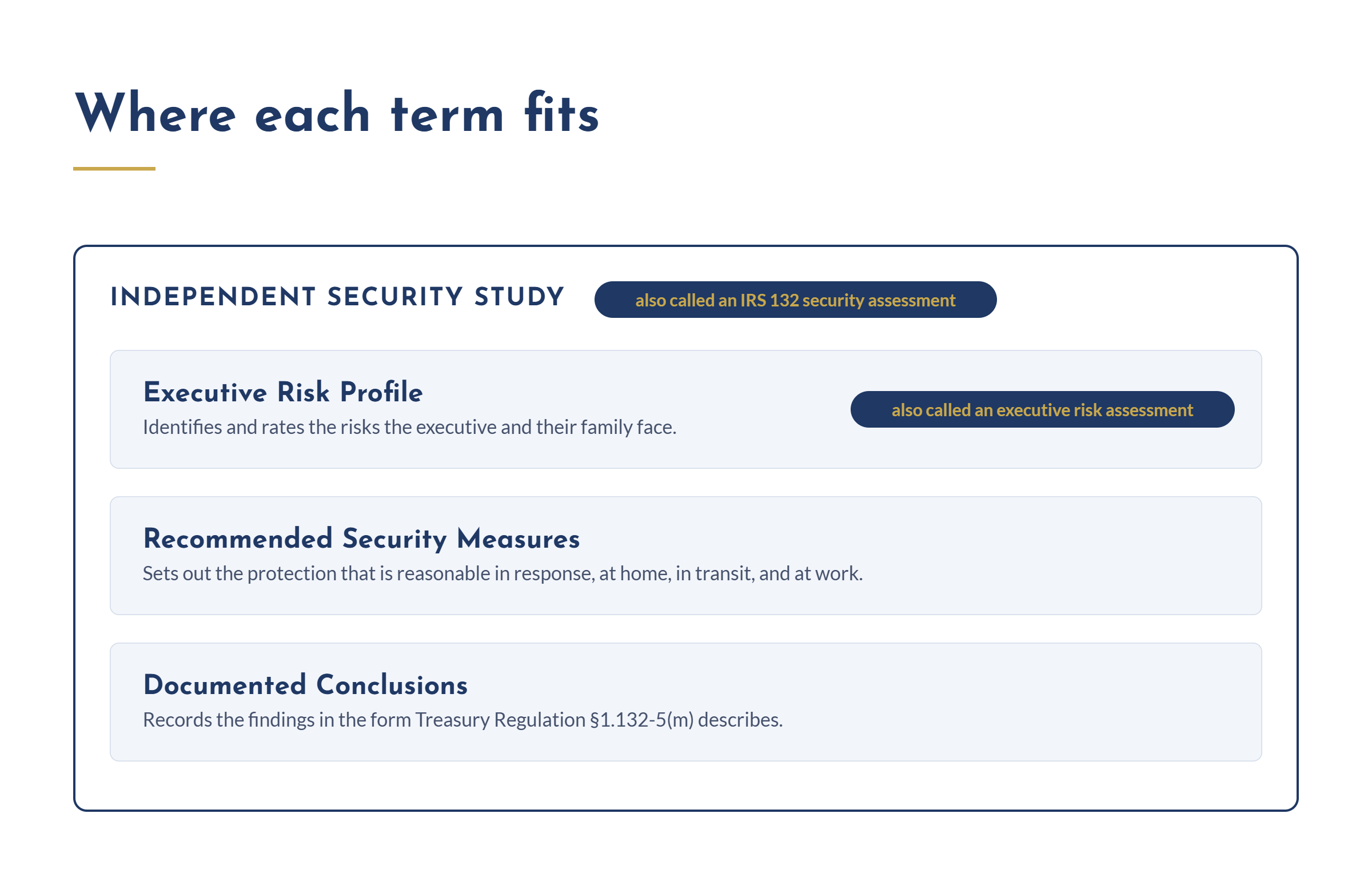
Where the Three Names Come From
Independent Security Study comes from the regulation itself. Paragraph (m)(2)(iv) of Section 1.132-5 is headed “Effect of an independent security study,” and security consultants use that phrase, often shortened to ISS, for the work it describes.
IRS 132 security assessment comes from the tax side. Section 132 of the Internal Revenue Code covers certain fringe benefits, and the regulation sits under it. People who come to the subject through tax or finance often refer to the work by the section number: a 132 study, a Section 132 assessment, or an IRS 132 security assessment. None of these is an official title. The number refers to a section of the tax code, not to a form or a certification.
Executive risk assessment comes from the security profession, where it means a review of the threats and exposures facing a particular executive. It is used for many purposes, and most of them have nothing to do with tax.
Independent Security Study
The regulation applies when an employee faces a bona fide business-oriented security concern, meaning a specific basis for concern about that person’s safety. It then describes two ways for the employer to show an overall security program. The first is protection on a 24-hour basis. The second is an independent security study, and it carries four conditions:
- An independent security consultant performs the study with respect to the employer and the employee.
- The study is based on an objective assessment of all the facts and circumstances.
- The study recommends that a 24-hour program is not necessary, and that recommendation is reasonable.
- The employer applies the study’s specific security recommendations to the employee on a consistent basis.
The term therefore means something specific. It names who performs the work, what the work rests on, what it concludes, and what the company does afterward. The full text is in Treasury Regulation Section 1.132-5(m).
The IRS 132 Shorthand
This is the same study under its tax-side name. If a tax director, an auditor, or outside counsel asks whether the company has a 132 study for an executive, they are asking for an Independent Security Study.
The shorthand is worth knowing for a practical reason. The person who asks for the study and the person who commissions it often use different words. A general counsel may request an IRS 132 security assessment while the security team looks for an executive risk assessment, and the two requests can produce different work.
Executive Risk Assessment
An executive risk assessment identifies and rates the risks a particular executive faces. It usually looks at the executive’s personal information, affiliations and public involvement, travel, threats, publicity, and online activity, along with the circumstances of the company and its industry.
That work is the foundation of any sound security decision. It also covers the same ground as the second of the four conditions listed above, an objective assessment of all the facts and circumstances.
What an executive risk assessment does not supply on its own are the other three. It may be performed by the company’s own security team, or by a provider that also sells the protection it recommends. It may describe risk without reaching a conclusion on whether a 24-hour program is necessary. And it may stop at findings, without the specific recommendations the employer is then expected to apply consistently.
None of this is ruled out by the text, which calls for an independent security consultant without defining independence. Each of them, though, leaves the company explaining why its assessment should count, if the question is ever put to it.
The two are better understood as nested than as rival options. An Independent Security Study opens with exactly this risk work, which in our practice is the Executive Risk Profile, and then supplies the three parts it lacks, extending the assessment to the protective program, offices, transportation and residences along the way. So a reader weighing one against the other is usually weighing a part against the whole, rather than choosing between two different products.
The Three Terms Side by Side
| Term | Where the name comes from | Who performs it | What it answers |
|---|---|---|---|
| Independent Security Study | Treasury Regulation Section 1.132-5(m)(2)(iv) | An independent security consultant | What protection is reasonable for this executive, and whether a 24-hour program is necessary |
| IRS 132 security assessment | Shorthand for the same study, taken from Section 132 of the Internal Revenue Code | An independent security consultant | The same questions |
| Executive risk assessment | The security profession | An in-house team, a protection provider, or an independent consultant | What risks this executive faces |
Which One to Ask For
If the company provides security to an executive and wants the record the regulation describes, ask for an Independent Security Study by name, and confirm the scope with your tax and legal advisors before the work begins. If the purpose is to understand an executive’s exposure, for planning or after a specific event, an executive risk assessment may be all you need.
Whatever a proposal is called, three questions show what you are being offered:
- Is the consultant independent of the providers who would deliver what the study recommends?
- Will the study conclude whether a 24-hour program is necessary?
- Will it give specific recommendations, with a way to track how they are applied?
Questions of tax treatment and disclosure belong with the company’s tax and legal advisors. The study’s role is to give those advisors an accurate, well-documented factual record.
Sentinel Protection Solutions performs each study as an independent advisor. We do not sell protective services, equipment, or installations, and we accept no referral fees. For more on that standard, see Why Independence Matters in an Independent Security Study.
To learn more, see our Independent Security Study page. If your organization is deciding which of these it needs, we welcome a confidential conversation.
